
SIP vs EMI: Same 3 Letters, Very Different Financial Result
SIP and EMI are both three-letter words with fixed monthly commitments, yet they lead to completely different financial outcomes. This blog explains, in simple terms, how SIP helps you create long-term wealth through compounding, while EMI helps you repay loans with interest. Understand the mindset shift needed to balance SIPs and EMIs wisely and build a financially secure future.
12/14/20253 min read

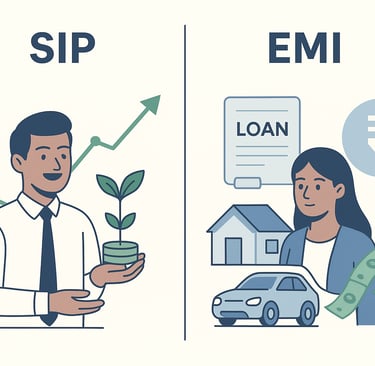
SIP and EMI: Same 3 Letters, Very Different Financial Results
SIP and EMI are two very common financial terms in our daily lives. Almost every earning individual in India deals with at least one of them, and many deal with both at the same time. Interestingly, both SIP and EMI are three-letter words, both usually involve a fixed monthly amount, and both require discipline.
But despite these similarities, the financial results they produce are completely opposite.
One helps you build wealth, while the other helps you repay debt. Understanding this difference is extremely important if you want to improve your long-term financial health.
What Is SIP and How Does It Work?
SIP stands for Systematic Investment Plan. It is a method of investing in mutual funds where you invest a fixed amount at regular intervals, usually every month.
When you start a SIP, your money gets invested in a mutual fund scheme and buys units based on the market price at that time. Over a long period, this regular investing helps you benefit from rupee cost averaging and compounding.
The biggest advantage of SIP is discipline. You don’t have to time the market or worry about daily price movements. You simply invest regularly and let time and compounding do the work.
SIPs are generally used for long-term goals such as retirement planning, children’s education, wealth creation, or financial independence.
What Is EMI and Why Is It Necessary?
EMI stands for Equated Monthly Instalment. It is the fixed amount you pay every month to repay a loan. This could be a home loan, car loan, education loan, or personal loan.
Every EMI has two parts:
One part goes towards repaying the principal
The other part goes towards interest charged by the lender
Unlike SIP, EMI does not create wealth. It helps you reduce a liability. While loans are sometimes necessary—especially for big-ticket items like a house—EMIs involve interest, which is a cost you pay over time.
In simple words, EMI is about fulfilling today’s needs by borrowing from your future income.
Same Monthly Amount, Completely Different Outcome
Here is where things become interesting.
Suppose two people commit to paying ₹10,000 every month for 20 years.
One person invests this amount through a SIP in an equity mutual fund. Over time, thanks to compounding, the total investment of ₹24 lakh can grow into a very large corpus, potentially crossing ₹1 crore depending on market performance.
The second person pays ₹10,000 as EMI for a loan. After 20 years, the loan is closed. There is no asset created from those monthly payments. The money is gone, except for the relief of being debt-free.
The discipline is the same. The effort is the same.
The result is completely different.
SIP Uses Compounding, EMI Suffers From Interest
SIP works on the power of compounding, where your returns also start earning returns. The longer you stay invested, the more powerful compounding becomes.
EMI works on interest, where you pay extra money to the lender for using borrowed funds. If the loan tenure is long, the total interest paid can be very high.
That is why SIP is often described as “making money work for you,” while EMI is “working to pay money back.”
Why SIP Feels Optional and EMI Feels Mandatory
Most people treat EMI as compulsory because missing an EMI affects credit score and attracts penalties. SIP, on the other hand, is often seen as optional and is the first thing to be stopped during financial stress.
This mindset is dangerous.
In reality, SIP is what secures your future, while EMI only manages your present. Skipping SIPs for years can cost you heavily in terms of lost compounding benefits.
A small SIP started early is far more powerful than a large SIP started late.
The Smarter Way: Run SIP Alongside EMI
This does not mean loans should be avoided completely. Loans like home loans or education loans are often necessary and practical.
The smart approach is:
Take only necessary loans
Avoid high-interest debt as much as possible
Always try to run at least a small SIP alongside your EMI
Increase SIP amounts as EMIs reduce or get closed
Even a modest SIP started during your loan tenure can make a significant difference over the long term.
A Simple Mindset Shift That Changes Everything
Many people ask:
“After paying EMIs, how will I manage SIP?”
A better question is:
“If I don’t do SIP now, how will I manage my future?”
This shift in thinking separates people who only earn money from those who build wealth.
Conclusion: Same Discipline, Two Financial Paths
SIP and EMI may look similar on paper, but they take you on two very different financial journeys.
EMI brings responsibility and helps you clear debt.
SIP brings growth and helps you create wealth.
A financially strong individual understands both and ensures that SIP is never ignored while managing EMIs.
If you want your money to grow and work for you, SIP must be a non-negotiable part of your financial life.